
Embers

I would not have guessed it sounds like rain.
“What is that?” My wife asks. My brain is barely coming to, just wanting to return to sleep. “Nothing,” I want to say, but I’m not even sure if I get the word out. It’s either rain, or something falling from the roof in quick drips, an enormous bag of potato chips being crinkled.
She’s moving already, gathering jackets and passports, and now I see the glow, now I hear that it’s not rain at all. The crackling is louder now, the world being ripped apart. I reach for the first article of clothing in my drawer, just to be decent when I go peek around the building to see what’s causing the noise outside our bedroom window. Basketball shorts. Chicago in January and I’m in basketball shorts. I’m still fooling myself into thinking I’ll go back to sleep soon.
I open the back door by the kitchen and see smoke, embers. I shut the door, get some pants on, go get a better look from the window by the dining room as I dial 911. 1:14 a.m, my call log marks the occasion. There’s a boom at some point during all of this, too loud for comfort, and yet its place in the order of events in my mind is already lost. Was I in bed still? Reaching for the phone? Rushing out the door?
Now I see that the flames from the restaurant next door are crawling over the wooden fence they put up just this past summer before they opened. This was after they put up the brick wall that blocked all our sunlight, long after the neighborhood spot they took over shut its doors. “Tony’s tired of sweeping,” the owner was quoted when asked by a local paper about his reason for closing up shop. I had spoken to him at least once a week for years and had never known him to speak in the third person. “Tony just wants to sit on the porch.”
I get more clothes on, appropriately lengthed this time, as my wife gathers our toddler, who immediately bursts into confused tears. I double check passports, but my wife’s brain is serving us both better than mine is. I double back and grab my citizenship certificate, because these are the times we live in. The call with 911 drops (my phone is shit) when I’m still giving our address, but by then we are out in the January air, and the lights are already dancing on the neigboring buildings. The trucks are there, plugged in, at work already. I turn back to summon our downstairs neighbor but she’s already pushing the door open.
I go back in to find my cat, accompanied by firefighters with their axes, just like the illustrations in the book I’ve read my son half a dozen times the past two days. The smoke is building, and I see glimpses of the fire reaching our deck. She’s not in her usual hiding spot under our bed, which I’m not surprised by. Eight years ago during the earthquake in Mexico she also found clever spots to hide. I whistle for her, note that the firefighters are wearing their muddy boots inside with a quickly-dismissed but not insignificant measure of annoyance. My poor girl will have to weather another disaster in hiding. It’s only later that I think about how the sound of the earthquake surprised me too, the way the buildings groaned in protest.
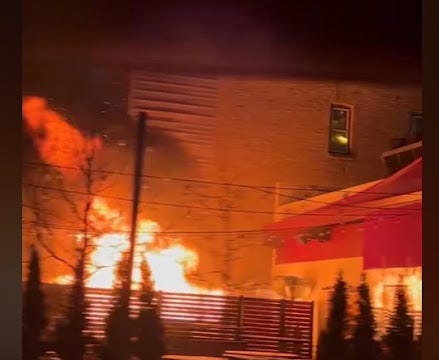
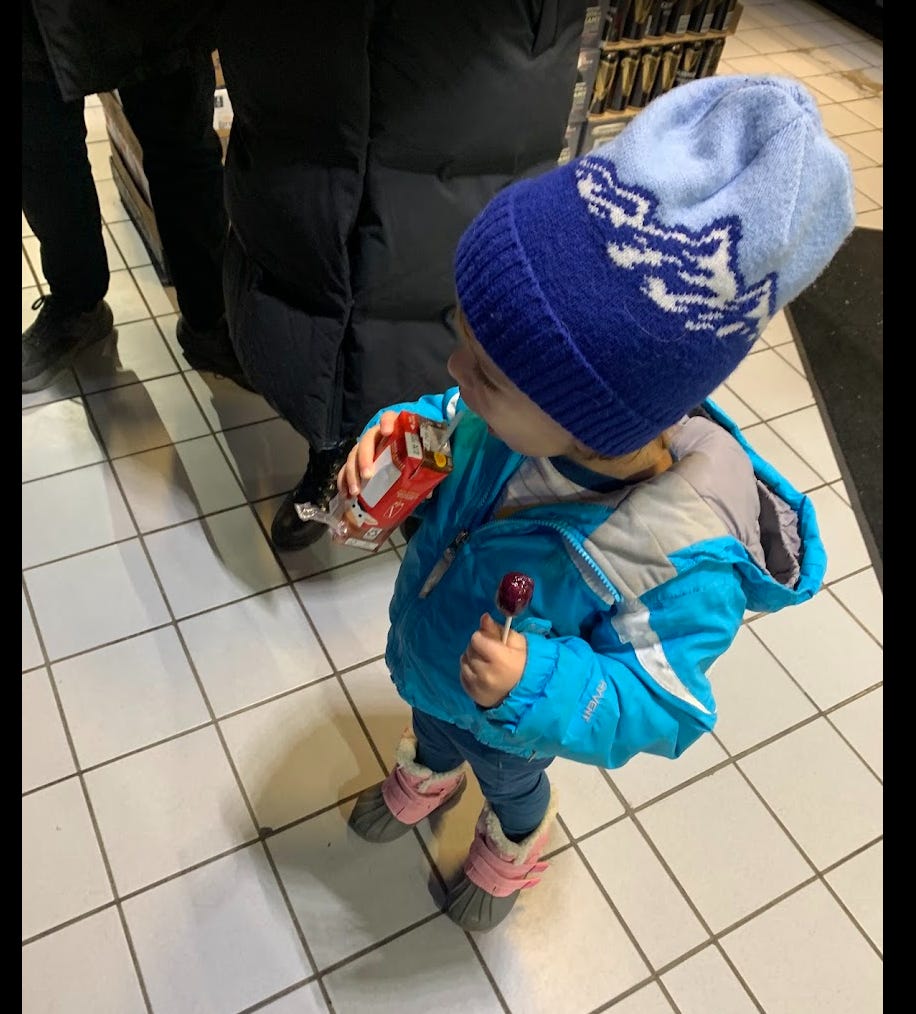
And then we are across the street, watching it all go down in safety. My son is shivering in my arms. He’s a Chicago boy through and through, has almost never admitted to being cold, and a part of him must be thrilled that he’s been allowed out without wearing a sweater. But now he comments on how it’s cool to see the trucks, the firefighters plugged into the hydrant. A couple of weeks ago I carried him through the snow at 6 a.m to catch a flight, calling it an adventure. He nodded happily then, and he will again soon, when the two mostly disinterested cops ask me and my neighbors if we have somewhere warm we can go and I suggest we go get a lollipop at the 24 hour convenience store a block away. A firefighter comes by and says they’ve looked for our cat and haven’t found her, but assures us the smoke is light and clearing, that they’ve “got a good knock” on the fire, and that she’ll be okay.
We traipse to the store, our neighbors and us. A young man in a suit speed walks past us, stumbling in the way of young men at 2 am on a Saturday headed for a convenience store. He buys a bag of chips and a gatorade. The employee at the convenience store gifts us water, and a grape lollipop, and some chocolate milk for our little Chicago boy, who’s now in great spirits and eager to play the slot machine by the front. The store clerk casts only passing strange glances when my wife and I take turns running up and down the aisles so that our son can watch us on the CCTV and giggle. It strikes me that I am just like my cat, because eight years ago after the earthquake I gathered with neighbors in the aftermath of two chaotic minutes and felt bonded by what we had all survived.
I walk back alone through the cold to see if the firefighters have cleared away. It is amazing how quickly the night air can turn into something to behold. A few scant snowflakes catch the glow of a streetlight, my footsteps scraping quietly on a street that’s almost never quiet. The fire investigator tells me it will be another twenty minutes, so I saunter back to the store, watching cars ahead of me u-turning as they spot the firetrucks blocking the road. Some drivers wear their curiosity on their faces, others their annoyance.
There’s a lottery machine by the entrance of the store, and my son learned his penchant for gambling from somewhere, so I slip a $5 bill in, feeling lucky. How could I not?
The proximity of death, I am not the first to point out, so easily brings to mind the sanctity of life.
Well before Saturday night and its hellish wake-up call, that sound that I will not be forgetting any time soon, decidedly not rain, I had these words in mind as my next topic to write about here. The sanctity of life, and our utter failure to honor it as a society.
Oh, we say the words often enough, though it hardly ever seems to be with wonder. It is rhetorically, sanctimoniously, with little attachment to life itself. To the snowflakes caught in the street light; the warm body shivering against us; the joy of a grape lollipop; peaceful, uninterrupted sleep; the shock of cold air when we know we have the relief of shelter coming soon; a million quotidian details that feel holy under a magnifying glass but fade to oblivion when not lit by the fire’s glow. It is so easy to forget, I feel it fading even now, two days later, with life and its practicalities intruding on the impulse to marvel at my luck.
The sanctity of life is something I wonder about so often these days when I look to the wider world, to people in power, whether the power they wield is a nation or a gun and impunity from their actions. I wonder when I see a country marching its way toward concentration camps carried by the fervent shouts of a third of its residents, many who claim their bloodthirst is in the name of the sanctity of life. I have never felt so blessed by the world that I would like to stomp others beneath my boot, but maybe I have not experienced the right kind of disaster.
Have they not placed themselves at the shore of death’s lake? Have they been so lucky as to not even feel it lapping at their toes? Have they not imagined it, those final moments, however they may come, and then felt the rush of thankfulness? Have they not thought of the ripples that extend back to the living? Have they never once taken a look at their power and their luck and felt thankful rather than possessive? How can you muster any anger at all if death is kept in mind? If you have held your child in the cold after being awakened to the sound of a fire licking at your bedroom wall?
I think, maybe, it’s because it is so much easier to act big and brash. To scream and beat your chest about how much you care about life and safety and people. But no one I know who values the sanctity of life does so loudly or with fervor. It is not a fire that rages, but rather delicate embers in the aftermath of something more harrowing. You do not fan them in order to burn more, consume more, but rather just to keep the glow alive, something with which to see by, a light with which to remember the only thing that matters.