
The Attempt

This is terrible news for every argument I formerly “won” about how the arts are inherently human and can never be replicated by machines. It’s even worse news for all those I planned to win in real or imagined conversations moving forward.
At least the article was released right before the deadline to join the class action lawsuit of authors vs Anthropic, providing a convenient reminder for me to cash in on perhaps the last paycheck I’ll ever get for my writing (I’ll be dubious that the courts in the US will actually force a corporation to write checks to artists until the money hits my bank account).
I went to a show recently here in Chicago, a variety act of sorts honoring actresses of the 80s and 90s, put on by local star and and prolific performer of delightfully weird shows Grelley Duvall. It was accompanied by a killer band pairing clips and recreations of scenes from deep cuts with over-the-top, impressive dance numbers, and, perhaps strangely, but for which I’ll offer no further details here, my son’s cinematic debut.

I left the theater feeling energized, delighted not just by the content and comedy of the past two hours, but for the fact that it was a show I could attend, for the show’s love letter to actresses, film, music and the human urge/desire/ability to create. And though it was an homage to an era, an impressive exercise in discovering niche performances, it was also the always-brave undertaking that every piece of art is: revealing to the world a sliver of your brain.
Even the most vapid, cynically-produced, bottom-line-driven action flick or serialized spy thriller reveals some sort of soul, some hint at the innerworkings of the mind most responsible for its creation, the view that mind holds of humanity.
Most works of art are to one extent or another are acts of collaboration, and are all the more interesting for it, a revelatory string of decisions leading to a final product. If those decisions somehow come together to create something profound, moving, comedic, or in some other way scratches the itch of what it means to be alive, it’s an impressive testament to the human ability to create, to express itself, a monument to talent, or better yet, talents working together.
If that string of decisions misses the mark, it is still delightfully revealing. Of how hard it is to make art. Of our willingness to attempt. Our burning desire to, regardless of the pitfalls. The many, many pitfalls. Our burning desire to make fools ourselves in the attempt to share some piece of our soul, some story that won’t unclaw itself from our minds unless we tell it to the world (or a room full of people, at least).
So perhaps AI can fool us. Congrats, robots, you’ve learned how to trick 7 billion simpletons. Now the least talented among us can write like an amalgamation of all the most talented voices in the course of human literature. And it seems that, unless we are told, we the audience are none the wiser when it comes to the final product.
But that’s just the thing. Art isn’t about the final product, not really. I’m sure a million tech-fanboys and girls are losing their shit right now and setting up “debate me” kiosks, some of them preparing their arguments by asking ChatGPT for talking points, many of which I’m sure will be valid and borderline convincing.
AI-produced art is focused on the product and not the process, which misses the point of creating art (exactly how you’d expect someone who didn’t care much for the humanities in school to miss the point).
If there's any kind of magic in this world it must be in the attempt of understanding someone sharing something. I know, it's almost impossible to succeed but who cares really? The answer must be in the attempt.
-from Before Sunrise
Part of the beauty of the Grelley Duvall show—of the opera I was fortunate enough to attend the next day, of the sporadic concerts I attend when the time and funds are right, of watching movies written by people, directed by people, performed by people—is knowing the time dedicated to whatever I’m taking in. Dance rehearsals, voice lessons, nights spent plugging away on some story burning to be told, and which fails again and again to unfold on the page the way it does in your head. Hours spent tinkering, whole drafts scrapped, one sentence you’re tinkering with for days, twelve takes of the same shot, wanting all the pieces to align just right. Failing anyway. Failing spectacularly.
Having the time to fail again and again until there is some slight measure of success (however we’re defining success here) is a luxury, particularly for artists, who aren’t exactly known for our ability to bring home the expendable income, save for the tippy top of the pyramid.
I know this better than most. After twelve years of sustaining myself just with writing income, I now work at a bookstore, teach classes online, tutor a Spanish student, am ghostwriting a romance story for a stranger across the world, and worked with an after school program running virtual escape rooms for elementary students. All this while caring for my child a few days a week, dropping him off at day care the other days, being the one in charge in my family for grocery shopping, cooking. Which is to say: time is absolutely a precious commodity to me. If there’s one thing artists and AI evangelists can agree on, it’s that.
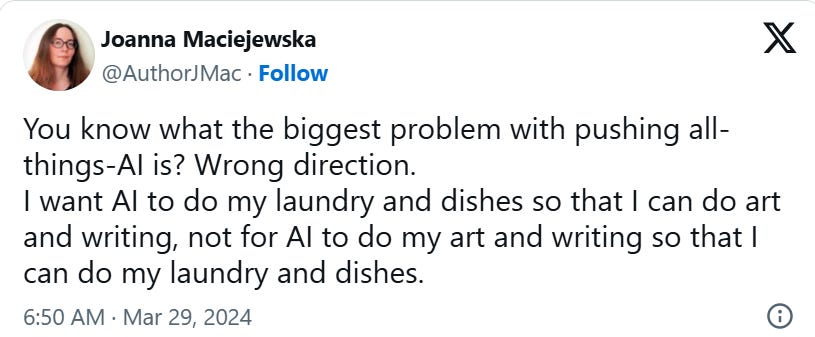
But even as my time flits away, becomes more and more precious, I do not want any bit of code that will make this part of my life less time-consuming.
Yes, I want more time. I silently (and sometimes not so silently) beg my son to go to sleep earlier, to get out the door sooner, nap longer, all for an extra few minutes of time in front of the computer stringing words together. Yes, I fantasize about functioning off 4 or 5 hours of sleep rather than 6 or 7 (though a little less so after reading Leila Lalami’s The Dream Hotel), and despite my annoying instance on cooking things from scratch, have begun buying jarred tomato sauce for pasta (gasp!).
As the world further funnels finances and resources upwards, consolidating more and more into the hands of fewer and fewer, making time more fleeting and less financially viable for anyone but consultants and those in private equity, of course I find myself greedily grasping for more time. Time to go watch a show with friends, time to sit on the couch with my wife and watch a terrible 80s movie together, and yes, time to write.
But the very time and effort spent on the final product that AI companies are trying to save us are crucial to what the final product is. Regardless of its quality, regardless of its financial success. The shortcut AI provides undercuts the very venture of art. So maybe the machines have fooled us now. Congrats.
I would never allow a computer algorithm to tuck my son into bed, regardless of how much more efficiently it could accomplish the task, regardless of how maddening it is to sit at the foot of his bed and fail at it. Because that’s a sort of art, too. Inefficient, slightly embarassing, always humbling. But what am I going to do? Not attempt? Outsource the task as if it’s a job and not part of life?
That is why I will never care how good AI is at recreating a final product. I don’t care that it can fool me. The beauty of art, of humanity, is in the attempt.
Wonderfully said! I couldn't agree more!